TAG-01
Terrestrial
Ecosystems
Regenerative Agriculture
Soils


The Environmental Value Chain
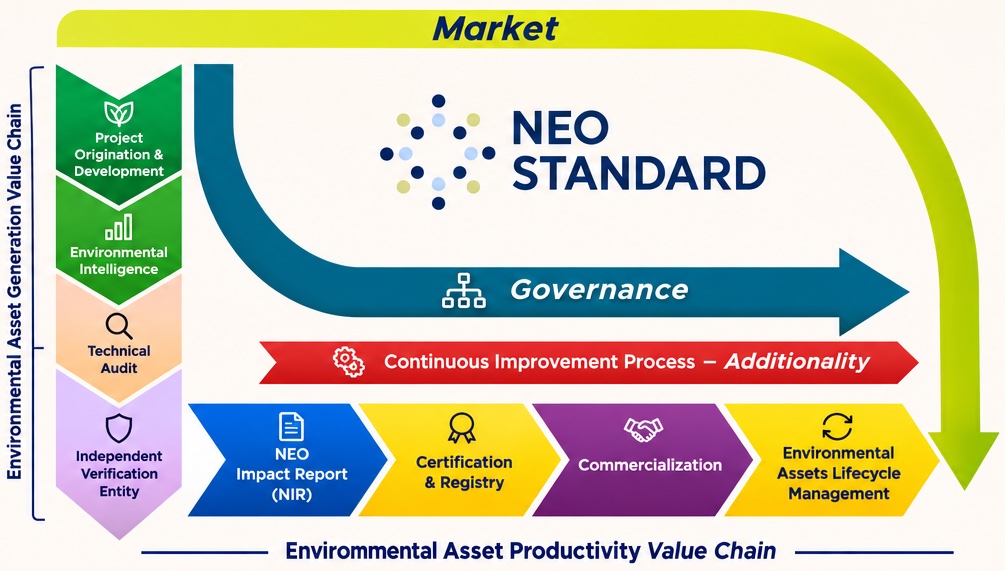
The NEO Environmental Standard is built around an explicit, integrated, and market-oriented Environmental Value Chain, designed to create value for all stakeholders across the environmental ecosystem and to serve as a comprehensive business framework for structuring, developing, and managing a new dimension of the environmental economy.
Its architecture combines five interconnected dimensions: Environmental Asset Generation, Environmental Asset Productivity, Governance, Continuous Improvement and Additionality, and Environmental Market Orientation.
Together, these dimensions connect the entire lifecycle of environmental assets, from project origination and environmental intelligence to certification, commercialization, and lifecycle management, within a unified framework designed to respond to the needs and evolving requirements of the global environmental market.
Six Integrated Dimensions. One Consistent Quantification Framework.
The NEO Environmental Standard introduces an integrated, multidimensional environmental analysis and quantification architecture, structured around six interconnected dimensions that establish a common methodological framework for measuring and quantifying environmental outcomes across different Types of Environmental Asset Generation (TAG).
This matrix-based approach combines structural, temporal, spatial, technological, and traceability criteria to transform environmental information into highly precise, reliable, and technically auditable quantified results. By relying on openly accessible environmental data, NEO enables independent validation, verification, and auditing of the underlying information, strengthening transparency, traceability, and confidence in environmental asset quantification.
Its design ensures consistent quantification principles while accommodating the specific characteristics and methodological requirements of different environmental asset categories.
Data from open and verifiable sources that enable independent validation, verification, and auditing.
Historical and productive analysis
Temporal nature of measured outcomes
Capture, reporting and certification frequencies
Spatial or material scope of measurement
Technologies and measurement procedures
Reconstruction and technical auditability
Measurable environmental outcomes with high precision, transparency, traceability, and methodological consistency.
DE FACTO / EX POST QUANTIFICATION
Environmental outcomes that have actually occurred and have been measured across the entire property under analysis.
Four Generation Categories. One Unified Environmental Standard.
The NEO Environmental Standard establishes a comprehensive Environmental Asset Generation Architecture designed to recognize and accommodate diverse sources of measurable environmental value. Rather than limiting its scope to carbon-related activities, NEO provides a unified framework for environmental asset generation across multiple environmental sectors, technologies, and project typologies.
This architecture is organized into four Types of Environmental Asset Generation (TAG): TAG-01 — Terrestrial, encompassing ecosystems, regenerative agriculture, and soils; TAG-02 — Aquifers, addressing aquatic and blue carbon environments; TAG-03 — Avoidance, covering clean energy and energy efficiency initiatives; and TAG-04 — Innovation, incorporating direct capture and emerging industrial and agricultural technologies.
Each TAG operates within the common principles, environmental integrity requirements, quantification architecture, and governance framework of the NEO Environmental Standard, while accommodating the specific methodological characteristics of its respective environmental activities. This integrated approach enables NEO to support the evolution and diversification of environmental assets without fragmenting the Standard into separate normative systems.
Ecosystems
Regenerative Agriculture
Soils
Aquatic Environments
Blue Carbon
Clean Energy
Energy Efficiency
Direct Capture
Industrial & Agricultural Technologies
Historical Environmental Intelligence. Measured Performance. Quantified Results.
The NEO Environmental Standard establishes an integrated Environmental Performance & Results Architecture designed to connect historical environmental intelligence with actual, measurable environmental performance. Through two complementary analytical profiles — the Environmental Historical Profile (EHP) and the Environmental Productive Profile (EPP) — NEO provides a continuous and structured framework for understanding environmental evolution and determining quantified environmental outcomes across the property under assessment.
The Environmental Historical Profile (EHP) analyzes the property’s environmental conditions and evolution over a historical reference period, typically covering the preceding five years. The Environmental Productive Profile (EPP) begins with the productive assessment period and progressively incorporates measured environmental performance throughout the project’s development and subsequent monitoring cycles. Both profiles are supported by satellite-based environmental observation and consistent analytical criteria, enabling continuity between historical characterization and productive performance.
By integrating historical environmental conditions with actual productive-period measurements, NEO establishes a traceable foundation for determining environmental performance and quantifying environmental results. These results are documented through the NIR — NEO Impact Report, providing a structured technical basis for subsequent assurance, certification, and registration processes, in accordance with the applicable requirements of the Standard.
Environmental conditions and evolution
(Historical reference period: 5 years)
Measured environmental performance
(Productive period and ongoing monitoring)
Continuous observation · Consistent analysis · Full property coverage